Convert Degrees and Percent
A converter for angles from degrees to percent and vice versa. The angle in degrees must be between -90 and 90, excluding these two values. 100 percent means, that a straight line spans the same distance in the length as is does in the height. This is at an angle of 45°. So there are percentages possible above 100. Negative degrees and percentages mean angles pointing down. Angles above 90 degrees cannot be represented in percentage notation.
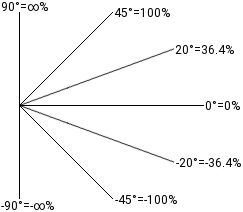
Please enter one value, the other will be calculated.
Formulas:
angle in percent = tan(angle in degrees) * 100%
angle in degrees = atan(angle in percent / 100%)
tan is the tangent, atan is the arc tangent. See also Calculate the Slope for the length and height.
It is difficult to convert these two values quickly in your head if you want to achieve a certain degree of accuracy, because we usually lack an intuitive understanding of the tangent. If it can be inaccurate, then you can estimate the angle as about half the percentage value, for angles below about 70 percent or 35 degrees a little more than half (the more, the smaller the angle), and for larger angles up to 100 percent or 45 degrees a little less. Above 45 degrees the percentage value then rises too quickly for reliable intuitive estimates without a calculator.
For the incline and decline of roads and paths, the values are often given in percent. In traffic planning jargon, the elevation profile is called a gradient; in road construction, this is expressed in percent, and in railway construction in per mille. To determine whether a traffic sign indicates an incline or a decline, simply read it from left to right. If it starts at the bottom left, it is an incline, otherwise it is a decline.