Calculate the Angle of Incidence and Angle of Reflection
Calculator for the angles of incidence and reflection, for the intermediate and direction angles at reflections and rebound. The angle of incidence equals the angle of reflection, at a movement against an obstacle and a reflection or rebound there. The obstacle can be, for example, a barrier or another solid object that is not displaced by the impact. In the case of reflection, when it comes to light, it can be something like a mirror. Here, the angles can be calculated for obstacles in a certain angle to the observer.
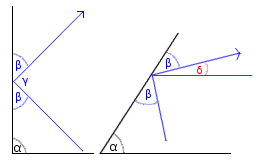
Please enter two values (not β and γ), or use or change the preset value for alpha and enter another angle. The other two values will be calculated. The surface angle α must be in the interval ]0°;180°[. Rounding is done to two decimal places. Here you can transfer angle units.
The formulas for calculating the four angles are:
γ = 180° - 2β
α = β + δ
The barrier or the obstacle that the object hits does not always have to be straight, of course. If it is curved, for example, then nothing changes in the underlying physics, but the surface angle α is then more difficult to determine.
It is a different matter if the impacting object has a spin or the obstacle that it hits is moving. In this case, angular momentum plays a role, which can noticeably influence the angle of reflection and further movement. Other angles can also arise if the obstacle is displaced by the impact or deformed by the collision.
In the case of partially transparent reflection, such as through the atmosphere or a transparent prism, the paths of light or other electromagnetic radiation can also be deflected.