Anzeige
Derivative and Integral of Trigonometric and Hyperbolic Functions
Formulas and graphs of derivatives and integrals of the trigonometric and hyperbolic functions. For the formulas of the integrals, the +C is omitted. Clicking ↓ shows the according graph.
Formulas
Trigonometric Functions
| Function | Derivative | Integral | Graph |
|---|---|---|---|
| sin(x) | cos(x) | -cos(x) | ↓ |
| cos(x) | -sin(x) | sin(x) | ↓ |
| tan(x) | 1+tan²(x) | -ln(|cos(x)|) | ↓ |
| cot(x) | -1-cot²(x) | ln(|sin(x)|) | ↓ |
| sec(x) | sec²(x)/csc(x) | ln(|sec(x)+tan(x)|) | ↓ |
| csc(x) | -csc²(x)/sec(x) | ln(|tan(x/2)|) | ↓ |
| sin²(x) | sin(2x) | (x-sin(x)*cos(x))/2 | ↓ |
| cos²(x) | -2*sin(x)*cos(x) | (x+sin(x)*cos(x))/2 | ↓ |
| tan²(x) | 2*sec²(x)*tan(x) | tan(x)-x | ↓ |
| cot²(x) | -2csc²(x)*cot(x) | -cot(x)-x | ↓ |
| sec²(x) | 2*sec²(x)*tan(x) | tan(x) | ↓ |
| csc²(x) | -2*csc²(x)*cot(x) | -cot(x) | ↓ |
| asin(x) | 1/√ 1-x² | x*asin(x) + √ 1-x² | ↓ |
| acos(x) | -1/√ 1-x² | x*acos(x) - √ 1-x² | ↓ |
| atan(x) | 1/(1+x²) | x*atan(x) - ln(1+x²)/2 | ↓ |
| acot(x) | -1/(1+x²) | x*acot(x) + ln(1+x²)/2 | ↓ |
| asec(x) | 1/(|x|*√ |x|-1 ) | x*asec(x) - arcosh(|x|) | ↓ |
| acsc(x) | -1/(|x|*√ |x|-1 ) | x*acsc(x) + arcosh(|x|) | ↓ |
Hyperbolic Functions
| Function | Derivative | Integral | Graph |
|---|---|---|---|
| sinh(x) | cosh(x) | cosh(x) | ↓ |
| cosh(x) | sinh(x) | sinh(x) | ↓ |
| tanh(x) | 1-tanh(x)² | ln(cosh(x)) | ↓ |
| coth(x) | 1-coth(x)² | ln(|sinh(x)|) | ↓ |
| sech(x) | -sech(x)*tanh(x) | atan(sinh(x)) | ↓ |
| csch(x) | -coth(x)*csch(x) | ln(|tanh(x/2)|) | ↓ |
| arsinh(x) | 1/√ x²+1 | x*arsinh(x) - √ x²+1 | ↓ |
| arcosh(x) | 1/√ x²-1 | x*arcosh(x) - √ x²-1 | ↓ |
| artanh(x) | 1/(1-x²); |x|<1 | x*artanh(x) + ln(1-x²)/2 | ↓ |
| arcoth(x) | -1/(x²-1); |x|>1 | x*arcoth(x) + ln(x²-1)/2 | ↓ |
| arsech(x) | -1/(x*√ 1-x² ) | x*arsech(x) - 2*atan(√ (1-x)/(1+x) ) | ↓ |
| arcsch(x) | -1/(|x|*√ 1+x² ) | x*arcsch(x) + arcoth(√ 1/x²+1 ) | ↓ |
Anzeige
Graphs
The graphs of function, derivative and integral of trigonometric and hyperbolic functions in one image each. The graph of a function f is blue, that one of the derivative g is red and that of an integral h is green. abs is the absolute value, sqr is the square root and ln is the natural logarithm.
Trigonometric Functions

Sine: function, derivative and integral

Cosine: function, derivative and integral

Tangent: function, derivative and integral

Cotangent: function, derivative and integral

Secant: function, derivative and integral

Cosecant: function, derivative and integral

Sine square: function, derivative and integral

Cosine square: function, derivative and integral

Tangent square: function, derivative and integral

Cotangent square: function, derivative and integral

Secant square: function, derivative and integral

Cosecant square: function, derivative and integral

Arcsine: function, derivative and integral

Arccosine: function, derivative and integral

Arctangent: function, derivative and integral

Arccotangent: function, derivative and integral

Arcsecant: function, derivative and integral

Arccosecant: function, derivative and integral
Hyperbolic Functions

Hyperbolic sine : function, derivative and integral

Hyperbolic cosine : function, derivative and integral

Hyperbolic tangent : function, derivative and integral

Hyperbolic cotangent : function, derivative and integral

Hyperbolic secant : function, derivative and integral

Hyperbolic cosecant : function, derivative and integral

Area hyperbolic sine : function, derivative and integral

Area hyperbolic cosine : function, derivative and integral

Area hyperbolic tangent : function, derivative and integral

Area hyperbolic cotangent : function, derivative and integral
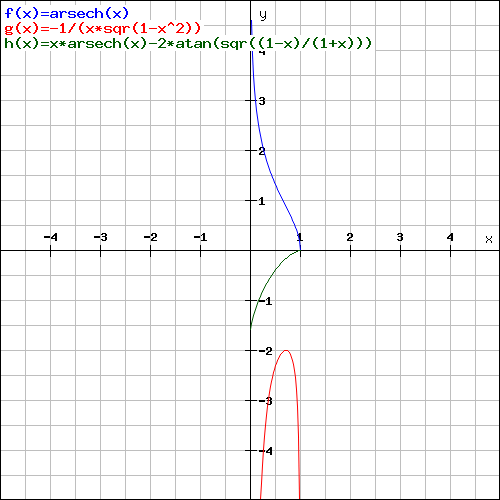
Area hyperbolic secant : function, derivative and integral

Area hyperbolic cosecant : function, derivative and integral
This page in German: Ableitung und Stammfunktion von trigonometrischen Funktionen und Hyperbelfunktionen.
The function graphs were made with the Function Graph Plotter.
Anzeige